Marketing Strategy in 2026: What It Was, What It Is, and What Comes Next
TL;DR
Marketing strategy has changed dramatically. What used to be a slow, campaign-led discipline is now a dynamic, data-rich, AI-assisted growth system. Here is how it evolved, where it stands today, and where it is heading next.
Marketing strategy sounds simple until you actually have to build one.
Everyone talks about content, campaigns, ads, social media, SEO, and now AI. But none of those things, on their own, are a strategy. They are execution. A real marketing strategy is the logic behind growth. It is the system that connects business goals, customer needs, positioning, channels, measurement, and decision-making into one coherent plan. The American Marketing Association defines strategic marketing as a focused approach that aligns marketing moves with big-picture business goals to create lasting competitive advantage.
That idea matters more than ever, because marketing has become both more powerful and more chaotic. We have more channels, more data, more tools, more expectations, and now a new layer of complexity: AI. The result is that many companies are doing more marketing than ever while feeling less certain about what is actually driving growth.
That is exactly why marketing strategy is back at the center.
Marketing strategy used to be slower, simpler, and more linear
To understand where marketing strategy is going, it helps to remember where it came from.
For decades, strategy was built around relatively stable models. Neil Borden introduced the idea of the marketing mix in 1953, and Jerry McCarthy later popularized the 4Ps in 1960: product, price, place, and promotion. Those frameworks gave marketers a practical way to think about demand creation in an era dominated by mass media, distribution control, and broad segmentation. Philip Kotler later reflected on how those classic models shaped modern marketing thinking over decades.
In that older world, strategy often followed a predictable rhythm. Brands ran annual planning cycles. Research was periodic. Campaigns were launched in waves. Performance data came in later. Optimization existed, but it was slower and far less granular than it is today.
That does not mean old marketing strategy was weak. In many ways, it was stronger in one important sense: it forced clarity. Companies had to answer fundamental questions. Who is the customer? What value are we offering? Why should anyone believe us? Where do we compete? How do we position ourselves? Those are still the right questions.
What has changed is the speed, the complexity, and the number of signals marketers can now use to answer them.
Marketing strategy today is no longer channel-first. It is system-first.
Modern marketing strategy is not just about choosing channels and launching campaigns. It is about building a growth system that can learn faster than the market changes.
Today's best strategies are shaped by continuous signals: search behavior, content performance, paid media efficiency, website trust, creative quality, brand perception, social proof, and increasingly, AI-mediated discovery. Strategic marketing now means connecting all of those inputs to business goals, not managing them in isolation. That shift is exactly why "strategic marketing" is now framed around sustainable growth and competitive edge, rather than short-term promotional wins alone.
This is also why the old split between "brand strategy" and "performance marketing" is becoming less useful. Great strategy now has to do both. It has to shape perception and prove impact. Gartner warns that companies are struggling to measure brand value, and predicts that CMOs who cannot demonstrate returns will lose influence with the C-suite. In other words, strategy is no longer admired for elegance alone. It has to survive scrutiny.
That is the real shift: marketing strategy has moved from planning activity to orchestrating evidence-based growth.
The biggest change: discovery itself is being rewritten by AI
For years, marketers optimized mostly for human behavior across search engines, social feeds, websites, and ad platforms.
Now there is a new gatekeeper in the journey: AI.
Google's own documentation is very clear on one important point. For AI features like AI Overviews and AI Mode, the fundamentals of SEO still matter. There are no extra technical tricks required. Pages still need to be indexed, eligible for snippets, and built around helpful, reliable, people-first content. Google also says generative AI can help with research and structure, but mass-producing pages without added value can violate spam policies.
That should wake up every marketer.
The future is not "SEO versus AI." The future is SEO plus GEO plus trust plus structure plus relevance. If AI systems increasingly summarize, compare, and recommend brands before a human even clicks, then your marketing strategy has to account for how your company is interpreted by both people and machines.
McKinsey's 2025 research argues that AI-powered search is already becoming a major discovery layer. It says half of consumers use AI-powered search today and projects that by 2028, AI-powered search could influence $750 billion in US revenue. Whether a company sells software, services, or physical products, that is not a side trend. That is a front-door change to how buyers discover and evaluate options.
This is where traditional marketing strategy starts to break if it is not updated. A strategy that ignores AI-mediated discovery is already outdated.
Personalization is no longer optional, but random personalization is not strategy
Customers now expect relevance. They do not want generic messaging, generic funnels, or generic offers.
McKinsey reports that consumers increasingly seek tailored digital interactions, and its research also notes that 71% of consumers expect personalized interactions while 76% become frustrated when they do not get them. It further argues that AI-driven personalization can improve satisfaction, increase revenue, and reduce cost to serve.
But here is the catch: more personalization does not automatically mean better strategy.
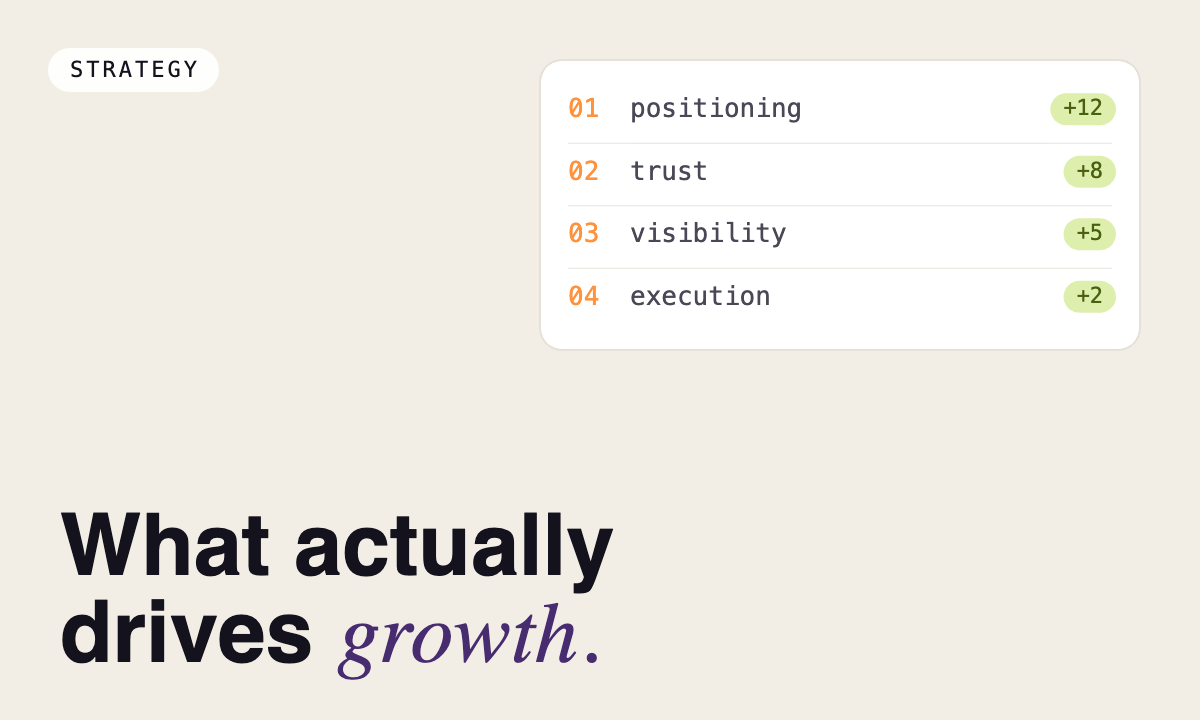
Bad personalization is just noise with data behind it. If your underlying positioning is weak, your website lacks trust, your content does not answer buyer questions, your paid traffic lands on poor pages, or your brand is invisible in AI and search discovery, then personalization just accelerates inefficiency.
Modern marketing strategy therefore has to work in the right order:
- Understand the market and the customer.
- Clarify positioning and value proposition.
- Audit the current growth system.
- Identify the highest-leverage gaps.
- Build channel plans that reinforce each other.
- Measure what actually changes revenue, trust, and pipeline.
That sounds obvious. Yet many teams still do the reverse: they start with content calendars, LinkedIn posts, or paid campaigns before they understand where the system is broken.
The future of marketing strategy will be AI-assisted, agentic, and more accountable
The next phase is not just "marketers using AI tools." It is AI becoming part of the operating model.
McKinsey's 2025 global AI survey shows that AI adoption is broad, but most organizations are still early in scaling it. It found 88% of respondents report regular AI use in at least one business function, while only about one-third say their companies have begun to scale AI programs. The same research highlights workflow redesign, governance, data, and operating model as major contributors to actual value creation.
Gartner is even more direct about what this means for marketing leaders. In late 2025, it reported that 65% of CMOs believe AI will dramatically change their role within two years, and only 5% of marketing leaders using GenAI merely as a tool reported significant gains on business outcomes. Gartner's conclusion is clear: AI does not create real value when it is bolted onto old workflows. It creates value when strategy, process, and talent are redesigned around it.
That is the future of marketing strategy in one sentence: less static planning, more intelligent orchestration.
In the next few years, strong marketing strategies will likely have these characteristics:
1. They will be continuously updated, not written once a year
Strategy will become a living system, refreshed by audit data, customer behavior, search visibility, creative performance, and competitive movement.
2. They will be multi-signal, not channel-siloed
SEO, GEO, content, trust, visual credibility, social authority, and paid media performance will not sit in separate decks anymore. They will be read together.
3. They will be partly machine-readable
Brands will need content, structure, metadata, proof points, and positioning that humans trust and AI systems can interpret correctly. Google already says helpful, indexable, snippet-eligible content is what matters for AI features.
4. They will require stronger governance
As AI becomes more autonomous, governance matters more, not less. Gartner explicitly frames future AI-ready marketing around oversight, data quality, human review, and trust.
5. They will be judged by business outcomes
The future CMO will not win by asking for more activity. They will win by proving commercial impact, shaping the value proposition, and helping the company adapt to AI-driven customer journeys.
So what should a good marketing strategy look like now?
It should be ambitious, but brutally grounded in evidence.
A useful modern strategy should answer questions like these:
- Where are we currently visible, and where are we invisible?
- What does our website communicate well, and where does it create doubt?
- Which channels create demand, and which ones just consume budget?
- How strong is our positioning compared with competitors?
- Are we discoverable in traditional search and AI-assisted discovery?
- Does our content educate, persuade, and convert, or just fill space?
- Are we measuring trust, attention, and conversion quality, not just clicks?
That is why generic strategy templates are weak. They sound polished, but they rarely diagnose reality.
A real strategy starts with audits.
Not audits for the sake of reporting. Audits for the sake of clarity.
When you review SEO, GEO, content, trust and visual signals, social presence, and paid channels together, you stop guessing. You can finally see where growth is constrained. Sometimes the issue is not traffic. It is credibility. Sometimes it is not messaging. It is discoverability. Sometimes it is not the ad account. It is the landing page. Sometimes the company does not need more activity at all. It needs a sharper growth logic.
That is where AI becomes genuinely useful.
Why AI should help build strategy, not just content
Most AI marketing tools are still used for surface-level output: draft a post, write an ad, summarize a report, generate a few ideas.
That is useful, but small.
The bigger opportunity is using AI to synthesize multiple audit signals into a strategic view. Not just "write faster," but "think clearer."
That is the idea behind Marqea AI CMO.
Instead of creating a generic strategy from prompts alone, Marqea AI CMO builds an individual marketing strategy based on what your business actually looks like across key growth dimensions. It can use audits such as SEO, GEO, Content, Trust/Visual, Social, and SEA to identify the real bottlenecks and the highest-leverage opportunities. The result is not a random checklist. It is a more intelligent path to growth.
That matters because the future belongs to companies that can connect diagnosis to action.
Not more dashboards. Not more disconnected tools. Not more marketing noise.
Better decisions.
Final thought
Marketing strategy used to be about planning what to say and where to say it.
Today, it is about understanding how growth really happens across a noisy, fragmented, algorithmic environment.
Tomorrow, it will be about orchestrating trust, visibility, relevance, and performance across both human and AI-driven journeys.
The companies that win will not be the loudest. They will be the clearest. They will understand their audience better, diagnose their growth system more honestly, and adapt faster than competitors when discovery, buyer behavior, and technology shift again.
That is what modern marketing strategy is becoming.
And frankly, that is far more exciting than the old playbook.
Ready to build a marketing strategy based on evidence, not assumptions?
Marqea AI CMO helps you create a tailored marketing strategy based on real audits across SEO, GEO, Content, Trust/Visual, Social, SEA, and more. Instead of starting with guesswork, you start with a clear view of where your growth opportunities actually are.
Explore Marqea AI CMO and turn your audits into a growth strategy →
FAQ
What is a marketing strategy?
A marketing strategy is the system that connects your business goals, target audience, positioning, channels, and measurement into one long-term plan for growth. Strategic marketing is about sustainable competitive advantage, not just short-term campaign activity.
How has marketing strategy changed over time?
It evolved from classic marketing-mix planning, built around frameworks like the 4Ps, into a more dynamic model shaped by digital data, personalization, and cross-channel measurement. Today, AI-assisted discovery and AI-powered workflows are pushing strategy into an even more adaptive phase.
Does AI replace marketing strategy?
No. AI can improve research, synthesis, workflow speed, and personalization, but it does not replace strategic judgment. Google explicitly says AI-generated content still needs to add value for users, and Gartner argues that AI creates meaningful gains only when companies redesign strategy and workflows around it.
What should a modern marketing strategy include?
At minimum: customer insight, positioning, channel prioritization, content direction, trust and brand signals, search and AI visibility, paid media logic, and clear measurement tied to business outcomes. Google's guidance for AI-era visibility still centers on helpful, reliable, people-first content and core SEO fundamentals.
Why are audits important before building a strategy?
Because a strategy built without diagnosis is mostly opinion. Audits reveal where your visibility, content, credibility, and channel performance are strong or weak, which makes it possible to build a strategy grounded in reality instead of assumptions. This is also consistent with the broader direction of modern marketing: more accountability, more evidence, and tighter alignment to business goals.